Secure Compliance Training with Corporate SSO
Introduction
When employees must complete mandatory compliance training, the method of access is not merely a technical consideration—it represents a critical governance imperative. Requiring separate usernames and passwords for training platforms can lead to loss of control, challenges in managing access, retention of accounts by former employees, and complications during audits.
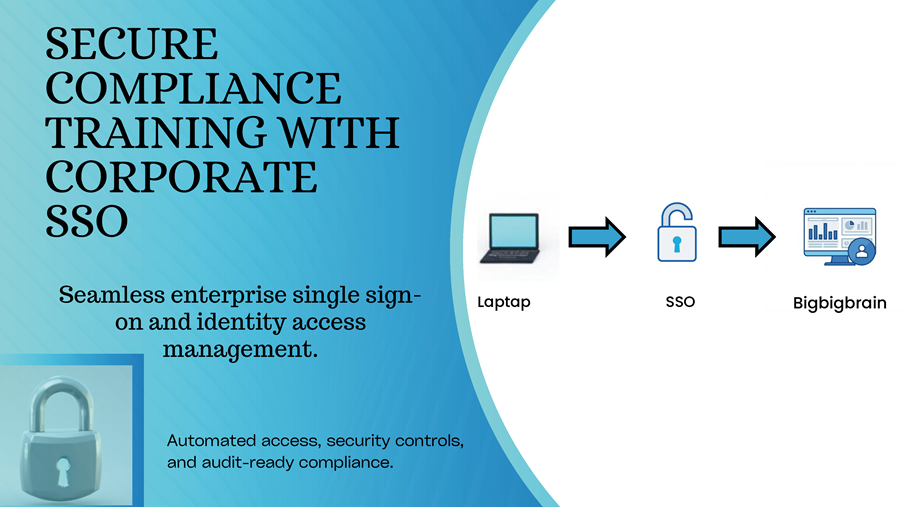
BigBigBrain.com addresses these issues by integrating seamlessly with corporate access systems, allowing employees to use the same credentials employed for daily operations. This approach ensures that training access adheres automatically to corporate rules as individuals join, change roles, or depart the organization, thereby maintaining governance, auditability, and alignment with enterprise security policies.
Technical Integration & SSO Compatibility (IT & Security Perspective)
BigBigBrain.com is engineered to support all standard enterprise identity and access management patterns, providing robust compatibility for IT and security teams. Key features include:
Single Sign-On (SSO) Standards
– SAML 2.0: Utilized by most enterprises for centralized authentication, enabling seamless login via corporate identity providers.
– OpenID Connect (OIDC): A modern authentication standard prevalent in cloud and Zero-Trust architectures.
Identity Providers & IAM Platforms
– Microsoft Entra ID (Azure AD)
– Okta
– Google Workspace
– ADFS
– Ping Identity
– ForgeRock
– Any SAML / OIDC-compliant provider
Directory & User Source Integration
– Active Directory (on-premise)
– LDAP directories
– Hybrid AD / cloud identity setups
Authentication & Security Controls
– Corporate Multi-Factor Authentication (MFA) inherited automatically
– Password policies enforced by the corporate IdP
– Conditional access rules (based on location, device, or risk assessment)
User Lifecycle Management
– Automatic user provisioning
– Automatic role and group assignment
– Automatic de-provisioning (for Joiner / Mover / Leaver processes)
– SCIM-based lifecycle automation
– Secure API-based provisioning from HR or IAM systems
Access Control
– Role-based access
– Group-based course assignment
– Entity-based segmentation (e.g., subsidiaries, departments, legal entities)
This architecture eliminates the need for a local identity store, duplicated users, or parallel security policies, ensuring a unified and secure environment.
What This Means for the Board & Decision-Makers
For boards, executives, and governance leaders, this integration means training access is managed with the same rigor as other critical corporate systems. It eliminates unmanaged accounts and unauthorized access by former employees, enhances accountability and auditability, and significantly reduces identity and security risks. This fosters a defensible compliance posture aligned with regulatory expectations.