Agile Made Simple: Streamlining IT Projects with Scrum, Kanban, and DevOps Essentials
Introduction
Modern IT organizations operate in an environment defined by rapid change, continuous delivery, and increasing pressure to innovate. Traditional, linear project management approaches often struggle to keep pace, resulting in delayed releases, misaligned teams, and growing technical debt.
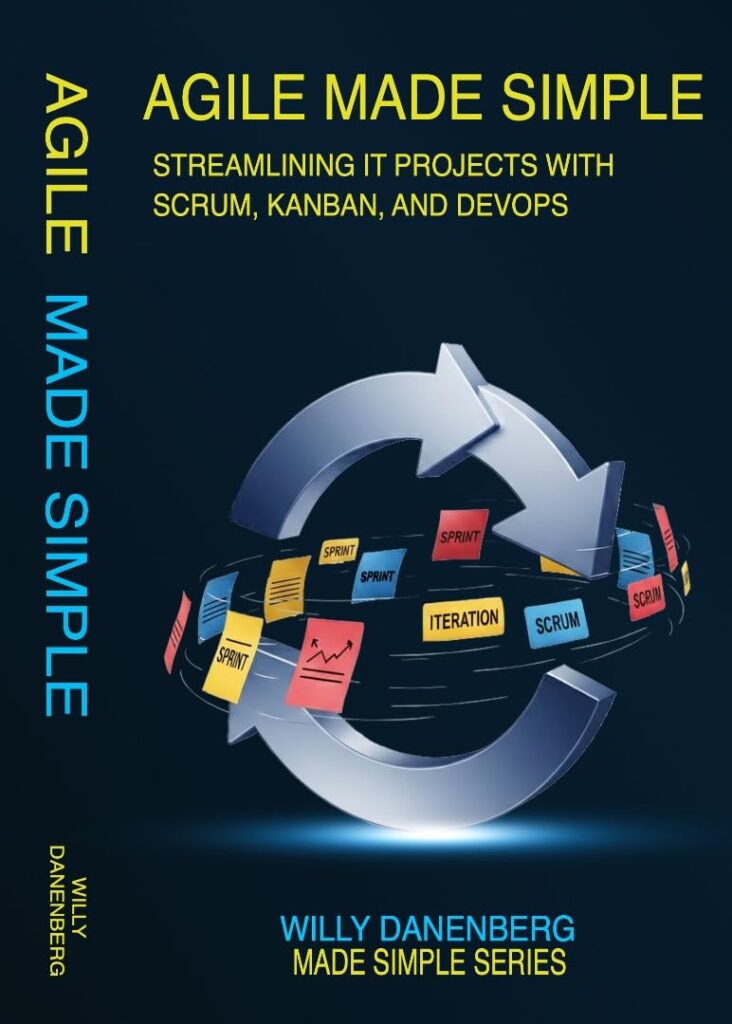
Agile Made Simple: Streamlining IT Projects with Scrum, Kanban, and DevOps Essentials by Willy Danenberg provides a clear, IT-focused introduction to Agile methodologies. Rather than treating Agile as a collection of buzzwords, the book explains how frameworks such as Scrum, Kanban, and DevOps principles can be applied pragmatically to improve delivery speed, quality, and collaboration across IT teams.
About the Author
Willy Danenberg is an experienced IT, governance, and transformation professional with decades of hands-on experience across software development, financial services, and regulated industries. His work has consistently focused on aligning technology delivery with business outcomes while maintaining control, quality, and compliance.
As a core author of the IT Made Simple Series, Danenberg is recognized for his ability to explain complex methodologies in clear, structured language. His writing balances historical context with modern practice, making frameworks immediately relevant to today’s IT environments.
Book Information: Agile Made Simple
Title: Agile Made Simple: Streamlining IT Projects with Scrum, Kanban, and DevOps Essentials
Author: Willy Danenberg
Publisher: PayServices BV
Publication Date: October 22, 2025
Language: English
Length: 171 pages
ISBN: 979-8901194768
ASIN: B0FX9SQD64
Format: Kindle Edition / Paperback
Why Agile Made Simple Matters Today
IT projects today must contend with evolving customer expectations, emerging technologies, and increasing interdependencies across systems. Agile methods have become the default response, yet many organizations struggle to implement them effectively.
This book matters because it:
- Focuses specifically on Agile in IT environments
- Explains why Agile principles emerged and how they solve common IT challenges
- Bridges the gap between development, operations, and leadership
- Helps organizations avoid superficial or tool-driven Agile adoption
Rather than promoting Agile dogma, the book emphasizes informed, context-aware application.
Overview of Agile Made Simple
The book offers a practical overview of Agile thinking, tracing its evolution from early software development frustrations to its role in modern IT delivery. Danenberg explains Agile values and principles using clear language and real-world IT examples.
Key areas explored include:
- Core Agile values and principles
- Scrum for structured sprint-based delivery
- Kanban for workflow visualization and continuous flow
- Extreme Programming (XP) for technical excellence
- Lean thinking in IT operations
- DevOps integration and automation
- Scaling Agile across large IT organizations
Each framework is presented with clarity and relevance to day-to-day IT work.
The Structure of the Book
The book is designed for both sequential reading and targeted reference:
- Foundational chapters introduce Agile history and core principles
- Framework-focused sections explore Scrum, Kanban, XP, and Lean
- Advanced chapters address scaling, DevOps, and enterprise adoption
- Practical guidance covers metrics, ceremonies, and planning tools
Visual aids and structured explanations support quick understanding and application.
Key Lessons from the Book
Several consistent themes emerge throughout the book:
- Agile is a mindset, not a toolset
Cultural change is more important than software tools. - Feedback loops drive improvement
Short iterations and continuous feedback reduce risk. - DevOps extends Agile beyond development
True agility requires integration with operations and automation. - Metrics should inform, not control
Measurements must support learning and improvement.
Practical Tools and Frameworks
The book provides a wide range of practical, IT-focused guidance, including:
- User stories, story points, and backlog management techniques
- Agile ceremonies such as stand-ups, retrospectives, and grooming sessions
- Metrics like burndown charts, cycle time, and deployment frequency
- Visual templates for Scrum and Kanban boards
- Case studies illustrating Agile adoption in fintech, enterprise IT, and DevOps teams
These tools are designed to be directly applicable using platforms such as Jira, Trello, or Azure DevOps.
Who Should Read Agile Made Simple
This book is ideal for:
- Software developers and engineers
- IT project and delivery managers
- Scrum Masters and Agile coaches
- DevOps and operations professionals
- Technology leaders and CIOs
- Business stakeholders working with IT teams
It is suitable for both Agile newcomers and experienced professionals seeking a clearer, IT-centric perspective.
Conclusion
Agile Made Simple: Streamlining IT Projects with Scrum, Kanban, and DevOps Essentials delivers a clear, practical, and modern introduction to Agile for IT professionals. Willy Danenberg successfully demystifies Agile frameworks and connects them directly to real-world delivery challenges.
For organizations seeking faster delivery, higher quality, and stronger collaboration across IT, this book provides a reliable and accessible roadmap.
FAQs
Is this book suitable for Agile beginners?
Yes. It explains Agile concepts clearly and builds understanding step by step.
Does the book focus specifically on IT projects?
Yes. All examples and frameworks are framed within IT and software environments.
Does it cover DevOps practices?
Yes. DevOps principles and their integration with Agile are explained in detail.
Is the book useful for executives and non-technical leaders?
Yes. It explains Agile benefits and leadership implications clearly.
Can this book be used as a reference guide?
Yes. Its structured format makes it suitable for ongoing reference.