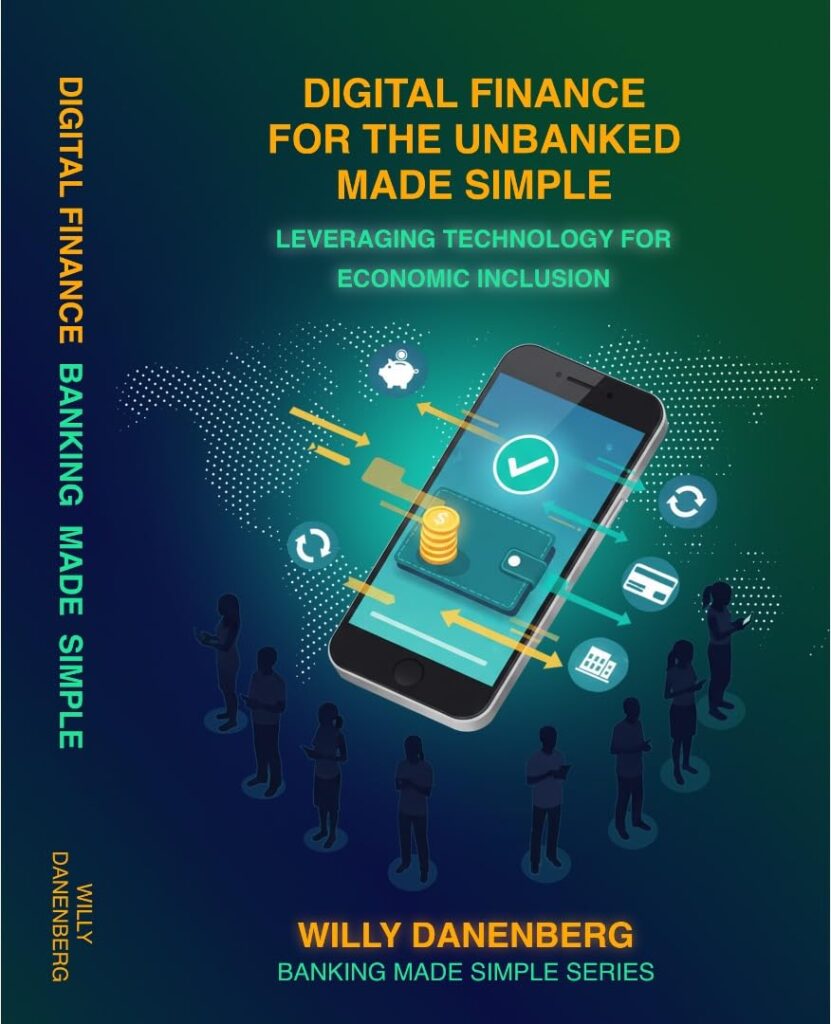
Digital Finance for the Unbanked Made Simple: Leveraging Technology for Economic Inclusion
Introduction
Digital technology has the potential to reshape financial inclusion at a global scale. For billions of unbanked and underbanked individuals, mobile phones, digital wallets, and fintech platforms offer a pathway to economic participation that traditional banking has failed to provide.
Digital Finance for the Unbanked Made Simple: Leveraging Technology for Economic Inclusion by Willy Danenberg explains how technology can be applied responsibly and effectively to close this gap. Rather than focusing on hype, the book delivers practical guidance for turning digital finance into a tool for dignity, access, and sustainable development.
About the Author
Willy Danenberg is a seasoned expert in banking, payments, fintech, and regulatory compliance, with decades of experience spanning financial institutions, technology providers, and public-sector initiatives. His work consistently bridges the divide between innovation and responsibility.
As the author of the IT Made Simple and Banking Made Simple series, Danenberg is recognized for transforming complex regulatory, technological, and financial concepts into structured, actionable guidance. His approach emphasizes human-centered design, risk awareness, and real-world applicability-qualities that define this book.
Book Information: Digital Finance for the Unbanked Made Simple
Title: Digital Finance for the Unbanked Made Simple: Leveraging Technology for Economic Inclusion
Author: Willy Danenberg
Publisher: PayServices BV
Publication Date: December 19, 2025
Language: English
Length: 203 pages
ISBN: 979-8902135791
ASIN: B0G92ZK3L1
Format: Kindle Edition / Paperback
Series: Banking Made Simple (Book 2 of 3)
Why Digital Finance for the Unbanked Matters Today
Traditional banking systems often exclude those who lack formal identification, stable income, or physical access to branches. Digital finance offers an alternative—but without thoughtful design, it can introduce new risks, inequalities, and failures.
This book matters because it:
- Moves beyond theory to implementation
- Balances innovation with consumer protection
- Addresses affordability, accessibility, and trust
- Recognizes regulatory realities in emerging markets
- Keeps inclusion-not technology-as the primary goal
Danenberg positions digital finance as a means to empowerment, not an end in itself.
Overview of Digital Finance for the Unbanked Made Simple
The book provides a clear roadmap for leveraging technology to expand financial access. It demystifies advanced concepts while remaining grounded in practical realities.
Readers gain insight into:
- Mobile money ecosystems and digital wallets
- Fintech platforms and API-driven services
- Blockchain applications for inclusion
- Identity, authentication, and risk management
- Regulatory and compliance considerations
- Scaling digital financial services responsibly
Each chapter is structured to move from concept to execution.
Technology as an Enabler, Not a Barrier
A core theme of the book is that technology must serve people—not the other way around. Danenberg emphasizes simplicity, usability, and trust, especially for first-time users of financial services.
The book explains how to:
- Design intuitive digital financial products
- Reduce friction for low-literacy and low-connectivity environments
- Address cybersecurity and fraud risks
- Avoid exclusion through poor UX or excessive compliance friction
- Build systems that scale without losing accountability
This human-centered approach distinguishes the book from purely technical fintech guides.
Practical Frameworks and Implementation Guidance
Rather than promoting abstract innovation, the book provides actionable frameworks that practitioners can apply immediately, including:
- Step-by-step implementation models
- Risk and compliance alignment strategies
- Technology selection criteria
- Governance and oversight structures
- Metrics for measuring inclusion impact
These tools help organizations move from pilot projects to sustainable, scalable solutions.
Who Should Read This Book
This book is especially valuable for:
- Fintech founders and product leaders
- Policymakers and regulators
- NGOs and development organizations
- Financial institutions pursuing inclusion
- Community leaders and program designers
- Investors focused on impact finance
It speaks equally to strategic decision-makers and operational teams.
Conclusion
Digital Finance for the Unbanked Made Simple offers a rare combination of vision, realism, and practical guidance. Willy Danenberg demonstrates that digital finance can be both innovative and inclusive-if it is designed with care, responsibility, and respect for the communities it serves.
For anyone committed to building financial systems that truly leave no one behind, this book is an essential resource.
FAQs
Is this book technical?
It explains technology clearly without requiring a technical background.
Does it address regulation and risk?
Yes. Regulatory compliance and risk management are core themes.
Is it suitable for emerging markets?
Absolutely. The book is written with developing and transitional economies in mind.
Does it focus on real-world implementation?
Yes. The emphasis is on practical execution, not theory.
Is this part of a series?
Yes. It is Book 2 of the Banking Made Simple series.