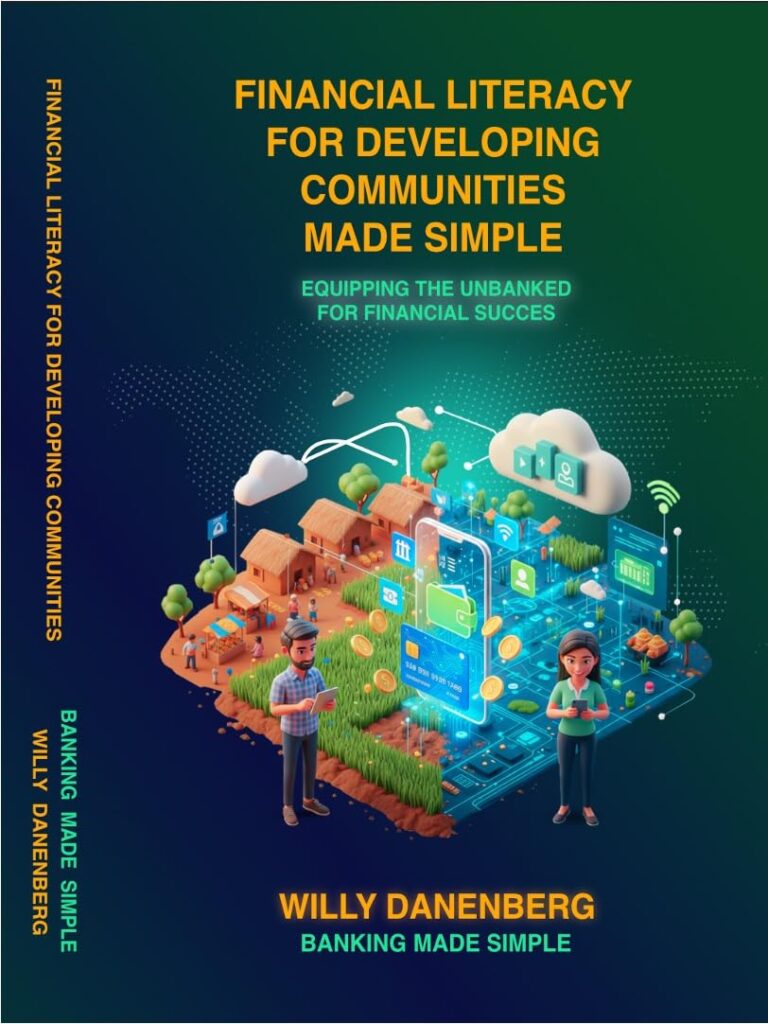
Financial Literacy for Developing Communities Made Simple: Equipping the Unbanked for Financial Success
Introduction
Financial exclusion remains one of the most persistent barriers to economic empowerment in developing communities. Millions of people worldwide remain unbanked or underbanked-not due to a lack of motivation, but because financial systems are often complex, intimidating, or culturally misaligned with their realities.
Financial Literacy for Developing Communities Made Simple: Equipping the Unbanked for Financial Success by Willy Danenberg addresses this challenge head-on. The book provides a clear, practical framework for teaching financial literacy in a way that is accessible, respectful, and effective-bridging the gap between formal financial systems and underserved populations.
About the Author
Willy Danenberg is an experienced financial services, governance, and education professional with decades of global expertise in banking, payments, compliance, and community-focused financial inclusion initiatives. His work spans both highly regulated financial institutions and grassroots education programs.
Through the Banking Made Simple and IT Made Simple series, Danenberg is known for translating complex systems into clear, actionable guidance. His approach emphasizes practicality, cultural awareness, and real-world impact-making his work especially valuable for educators, NGOs, policymakers, and financial institutions serving diverse communities.
Book Information: Financial Literacy for Developing Communities Made Simple
Title: Financial Literacy for Developing Communities Made Simple: Equipping the Unbanked for Financial Success
Author: Willy Danenberg
Publisher: PayServices BV
Publication Date: December 18, 2025
Language: English
Length: 317 pages
ISBN: 979-8902135814
ASIN: B0G8CSYNDB
Format: Kindle Edition / Paperback
Series: Banking Made Simple (Book 1 of 3)
Why This Book Matters
Financial literacy is more than understanding money—it is about confidence, trust, and empowerment. Many existing financial education resources assume prior knowledge, access to technology, or familiarity with banking systems that unbanked populations simply do not have.
This book matters because it:
- Starts from the lived realities of unbanked communities
- Addresses cultural mistrust and fear of financial institutions
- Focuses on practical, teachable skills rather than theory
- Provides tools that work in low-resource environments
- Empowers educators as much as learners
It treats financial literacy as a human capability, not an abstract economic concept.
Overview of the Book
Financial Literacy for Developing Communities Made Simple breaks financial education into clear, manageable building blocks that can be taught in community workshops, NGO programs, classrooms, or outreach initiatives.
Key focus areas include:
- Understanding money and basic financial concepts
- Budgeting and expense tracking using simple tools
- Saving strategies suited to irregular or low incomes
- Building confidence in using banks and financial services
- Overcoming fear, misinformation, and cultural barriers
- Designing inclusive financial education programs
Each chapter is written in plain language and designed for immediate application.
Practical, Community-Centered Approach
A defining strength of this book is its emphasis on how people actually learn. Danenberg draws on real-world experience to show how financial education succeeds-or fails-at the community level.
Readers learn how to:
- Build trust before introducing financial products
- Use relatable examples instead of abstract terminology
- Adapt lessons for varying literacy levels
- Address common fears around debt, banks, and formal systems
- Encourage participation through dialogue, not lectures
This makes the book especially effective in culturally diverse and resource-constrained settings.
Tools and Teaching Strategies
Rather than presenting financial literacy as a one-size-fits-all curriculum, the book offers adaptable tools and methods, including:
- Simple budgeting and saving exercises
- Workshop structures for group learning
- Practical examples drawn from daily life
- Step-by-step guidance for educators and facilitators
- Approaches for combining in-person and digital tools
These resources help educators move from intention to impact.
Real-World Impact and Use Cases
The book highlights how structured, accessible financial education can transform lives and communities. Case examples demonstrate how participants move from fear and uncertainty to confidence and control over their finances.
Use cases include:
- Community-based financial literacy workshops
- NGO and nonprofit education programs
- Bank-led inclusion and outreach initiatives
- Development projects focused on economic empowerment
The emphasis is always on measurable, human-centered outcomes.
Who Should Read This Book
This book is ideal for:
- Community educators and trainers
- NGOs and development organizations
- Financial institutions focused on inclusion
- Policymakers and social impact professionals
- Volunteers working with unbanked populations
- Anyone passionate about financial empowerment
It is equally valuable for program designers and frontline facilitators.
Conclusion
Financial Literacy for Developing Communities Made Simple is a powerful, compassionate, and practical guide to financial empowerment. Willy Danenberg delivers a resource that respects the realities of unbanked communities while providing educators with the structure and confidence to teach effectively.
For anyone committed to advancing financial inclusion and building real capability—not just awareness-this book is an essential foundation.
FAQs
Is this book suitable for people with no financial background?
Yes. It is written specifically for accessibility and clarity.
Does it help educators design programs?
Yes. The book provides structured guidance for workshops and learning initiatives.
Is it culturally sensitive?
Absolutely. Cultural context and trust-building are central themes.
Can it be used by banks and NGOs alike?
Yes. It is designed for cross-sector use.
Is this part of a series?
Yes. It is Book 1 of the Banking Made Simple series.